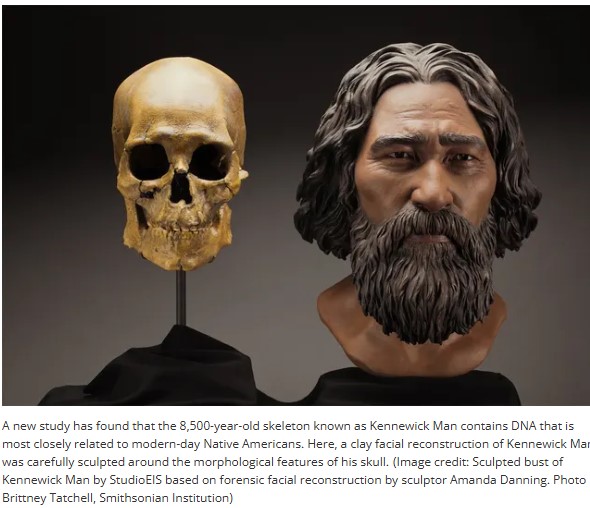
The remains of a prehistoric man, later known as the Kennewick Man, were discovered near Kennewick, Washington. This archaeological find would become significant in understanding early human migration and Native American prehistory.
To scientists, he is "Kennewick Man." To Native Americans, he is the "Ancient One." More than a decade ago, Native Americans lost their claim for custody of this 8500-year-old skeleton from Washington state, when a federal appeals court ruled there was no evidence he was related to any modern tribe.
**"Read More" BELOW for the complete story**
Now, after several false starts, researchers have succeeded in sequencing Kennewick Man's genome. Their conclusion: The Ancient One is closely related to at least one of the five tribes that originally fought to rebury him on spiritual grounds.
"This is great news for us," says Jim Boyd, chair of the business council of the Confederated Tribes of the Colville Reservation in Washington. Boyd says that the Colville people, who provided two dozen DNA samples for comparison with Kennewick Man, are now discussing whether to reclaim the skeleton under U.S. law.
The U.S. Army Corps of Engineers, which currently has legal custody of Kennewick Man, is also studying whether to return the nearly complete skeleton—which was found eroding from the shore of the Columbia River in Kennewick, Washington, in 1996—to the tribes.
When radiocarbon dating revealed that he was thousands of years old, a legal tug of war began between local tribes and scientists who wanted to study him, but ended in the tribes' defeat in 2004.
The findings are "ironic" given the long controversy over where the bones should end up, says lead author Eske Willerslev, a paleogeneticist at the University of Copenhagen.
"The reason we can come to these conclusions is because the skeleton was kept for science," and not reburied as the tribes had wanted, he told reporters during a news conference yesterday. "But the conclusions show that he was Native American in the first place."